
If you’ve ever paused mid-sentence wondering whether it’s “colum” or “column,” you’re not alone. This tiny spelling mix-up trips up writers, students, and even professionals every single day. The good news is that once you understand the simple rule behind it, you’ll never second-guess yourself again.
Colum or Column – Quick Answer
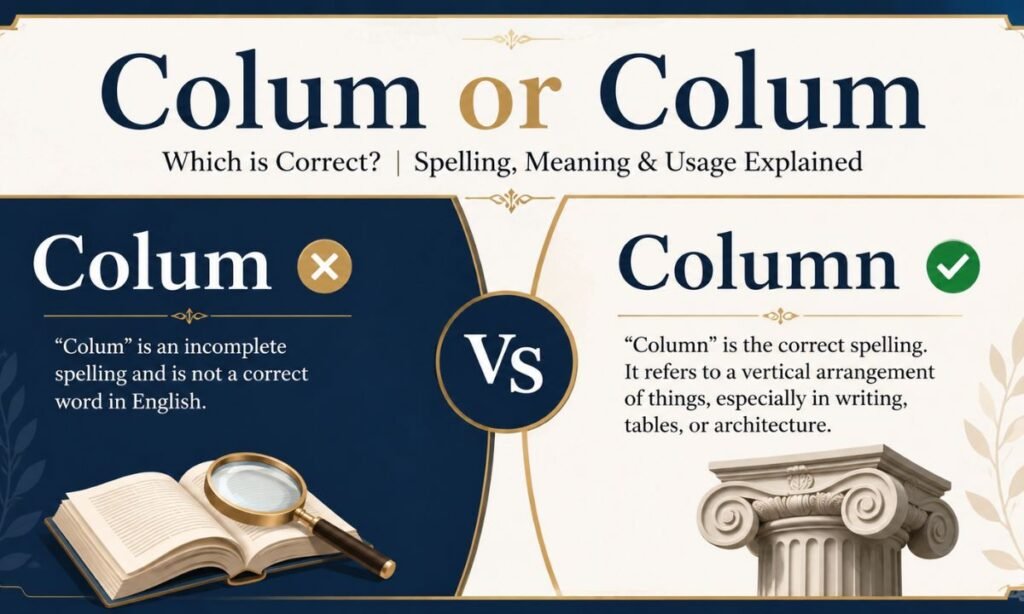
The correct spelling is column, not “colum.” The word always ends in “-mn,” with a silent “n” that doesn’t get pronounced but must be included in writing. “Colum” is simply a common misspelling, not an accepted variant in any form of English.
How to Spell Column Correctly (Common Variations Explained)
Here’s the breakdown people search for most:
- Correct spelling of column: c-o-l-u-m-n
- Colum vs column: “Colum” is incorrect; “column” is correct
- Column vs colum: Same answer, reversed order, same rule
- Column misspelling: Dropping the final “n” is the most frequent error
The confusion usually happens because the “n” at the end is silent. When you say the word out loud, it sounds like “COL-um,” which tricks people into writing it exactly how it sounds.
Related Post: Cognisant or Cognizant: Finally, a Clear Answer
The Origin of Colum or Column
The word “column” traces back to the column Latin origin, from the Latin word columna, meaning a pillar or support structure. It entered English through Old French colonne/columne, eventually settling into the modern spelling used today.
This history explains the silent “n.” Latin-derived words often carry letters that survived translation but lost their pronunciation over centuries of language evolution. Understanding column in English grammar roots helps explain why the spelling looks slightly different from how it sounds.
British English vs American English Spelling
Here’s some good news: this is one of the rare English words where British vs American spelling doesn’t create a split. Column is spelled identically in both regions.
Comparison Table
| Feature | British English | American English |
| Spelling | Column | Column |
| Pronunciation | /ˈkɒl.əm/ | /ˈkɑː.ləm/ |
| Plural Form | Columns | Columns |
| Usage in Writing | Same | Same |
| Usage in Data/Excel | Same | Same |
Unlike words such as “colour/color” or “organise/organize,” column stays consistent across English dialects worldwide.
Which Spelling Should You Use?
US Audience
American readers and publications use “column” exclusively. There’s no regional variant to worry about here, so you can write with confidence.
UK and Commonwealth Audience
The UK, Australia, Canada, and other Commonwealth countries also use “column.” Column meaning and spelling remain identical regardless of where your audience is based.
Global or Online Audience
If you’re writing for an international or online audience, “column” is the universally accepted spelling. It works in blogs, websites, and global publications without any localization needed.
Professional Writing
In business reports, journalism, or formal documents, accuracy matters. Using “colum” instead of “column” can look careless and reduce your credibility instantly.
Educational Context
Students learning column in writing and grammar should memorize the silent “n” early, since it’s a common error on essays, exams, and assignments.
Common Mistakes with Colum or Column
1. Dropping the Silent Letter
The most frequent mistake is writing “colum” because the “n” isn’t pronounced. Training your eye to always check for that final letter fixes this quickly.
2. Mixing with Similar Words
Some writers confuse column with variations like “collumn” or “coloumn,” adding extra letters that don’t belong. Neither variation is correct English.
3. Incorrect Plural Form
The plural is simply columns plural, adding “s” at the end. Avoid mistakenly writing “colums” or “columnns.”
4. Confusion in Data Tables
When working with spreadsheets, people sometimes misspell the word while labeling headers, especially under time pressure. This shows up often in column in spreadsheet and colum or column in excel searches.
5. Autocorrect Issues
Ironically, autocorrect tools sometimes fail to catch “colum” if it’s typed quickly, since it can resemble a valid short word fragment rather than a clear typo.
Correction Tips
- Say the word slowly and picture the spelling: col-UMN
- Remember it comes from “columna” (Latin origin)
- Use spell-check tools, but don’t rely on them completely
- Practice writing it in full sentences until it becomes automatic
Column Spelling, Meaning, and Pronunciation
Column spelling is fixed: c-o-l-u-m-n. In terms of column pronunciation, most English speakers say /ˈkɒl.əm/ (UK) or /ˈkɑː.ləm/ (US), both dropping the final “n” sound.
As for meaning, a column can refer to:
- A vertical structural pillar (as in architecture)
- A vertical section in a spreadsheet or table
- A regular feature in a newspaper or magazine, written by a columnist
- A formation, such as a “column of soldiers” or “column of smoke”
Related word forms include columnar (shaped like a column) and columnist (a person who writes a recurring opinion piece).
Colum or Column in Everyday Examples
Emails
“Please review the third column in the attached spreadsheet before our call.”
News Writing
“The columnist’s latest piece sparked debate across social media platforms.”
Social Media
Even casual captions benefit from correct spelling: “New column dropping every Friday, don’t miss it.”
Academic Writing
“The data was organized into five columns, each representing a different variable.”
Architecture
“The ancient temple featured tall stone columns supporting its roof.”
Seeing the word in real context across different fields makes it easier to remember the correct column example usage every time.
Colum or Column – Google Trends & Usage Data
Search behavior shows that “colum or column” and “column vs colum” are consistently searched queries, largely driven by people unsure about the silent letter. Interest tends to spike around back-to-school seasons and whenever spreadsheet or Excel-related tasks are common, since vertical column references appear often in data work.
“Column” remains the dominant search term overall, while “colum” appears mostly as a misspelling rather than an intentional search, confirming it isn’t a recognized alternative spelling.
Comparison Table: Keyword Variations Side by Side
| Term | Correct? | Common Use Case |
| Column | Yes | Standard, correct spelling |
| Colum | No | Common misspelling |
| Columns | Yes | Plural form |
| Colums | No | Incorrect plural |
| Columnist | Yes | Person writing a column |
| Columnar | Yes | Adjective form, column-shaped |
Extra Tips for Mastering Tricky Spellings Like This
Beyond memorizing “column,” building a broader habit of catching silent-letter words can help your writing overall. Words like “autumn,” “solemn,” and “condemn” follow the same silent “n” pattern, so learning one helps you remember the others.
Reading regularly and paying attention to how professional writers spell such words also reinforces correct usage naturally over time, without needing to memorize strict rules.
Frequently Asked Questions
Is it colum or column?
The correct spelling is always “column.” “Colum” is a misspelling and isn’t accepted in standard English.
Why does column have a silent n?
The silent “n” comes from the word’s Latin origin, columna, and has remained in the spelling through centuries of language evolution.
What is the plural of column?
The plural is “columns,” formed by simply adding “s” to the end.
Is column spelled the same in British and American English?
Yes, “column” is spelled identically in both British and American English, unlike many other words that differ between dialects.
What does column mean in Excel or spreadsheets?
In Excel, a column refers to a vertical set of cells, usually labeled with letters like A, B, and C.
What is a columnist?
A columnist is a writer who regularly contributes opinion or feature articles, known as columns, to a newspaper, magazine, or website.
Final Thoughts
The debate between “colum or column” really isn’t a debate at all. “Column” is the only correct spelling, used consistently across American, British, and global English.
Remembering its Latin roots and silent “n” makes it far easier to get right every time, whether you’re writing an email, formatting a spreadsheet, or drafting an article.
Once this small spelling detail clicks, you’ll write with more confidence and avoid one of the most common typos in everyday English.

Jessica is the founder and lead writer at Explain Wordz. She creates simple, accurate, and engaging content on English grammar, vocabulary, and writing to help learners improve their language skills with confidence.