If you’ve ever paused mid-sentence wondering whether to type “cognisant” or “cognizant,” you’re not alone. This is one of the most common spelling mix-ups in the English language, and it trips up native speakers just as often as learners.
The good news? The answer isn’t complicated once you understand where the word comes from and who you’re writing for. This guide breaks down the meaning, origin, regional rules, and real-world usage of cognisant and cognizant, so you never have to second-guess yourself again.
Cognisant or Cognizant: Quick Answer
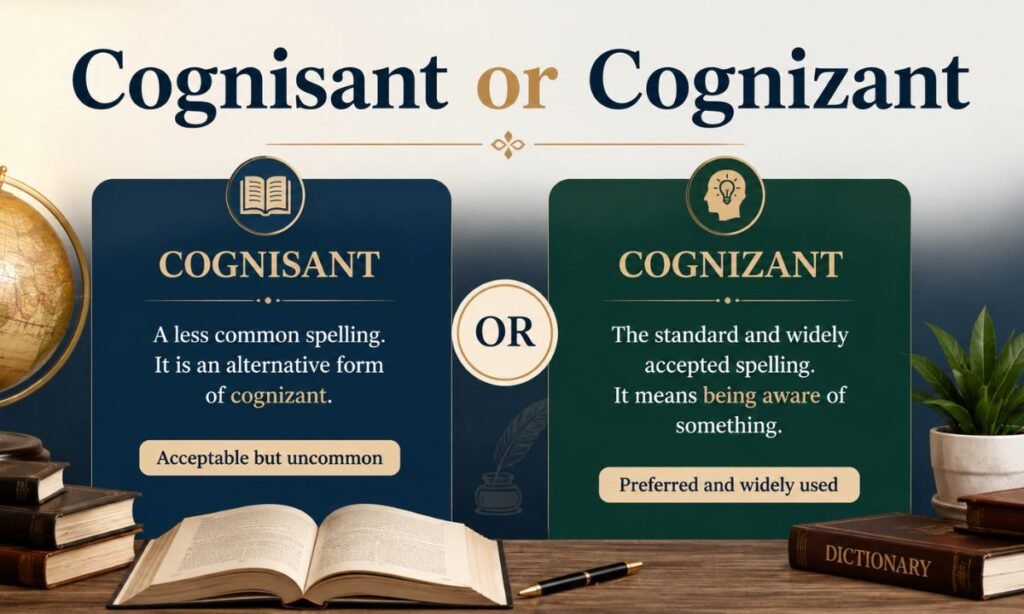
Both spellings are correct. The difference comes down to geography, not grammar.
- Cognisant is the British English spelling, used across the UK, Australia, New Zealand, and India.
- Cognizant is the American English spelling, used in the US and Canada.
Both words mean the same thing: being aware of, informed about, or having knowledge of something. There’s no difference in pronunciation, definition, or grammatical function. Only the letter “s” versus “z” changes depending on regional convention.
If you write for a global audience and aren’t sure which to pick, American English spelling tends to be more widely recognized online, but British spelling is perfectly acceptable for formal, academic, or Commonwealth audiences.
The Origin of Cognisant / Cognizant
The word traces back to the Latin verb cognoscere, meaning “to know” or “to become acquainted with.” It entered English through Old French and Anglo-Norman legal terminology, where it was originally tied to the noun “cognizance,” a legal term referring to jurisdiction or the right to try a case.
Over time, “cognizant” evolved into a general adjective describing awareness, moving beyond its courtroom origins into everyday and professional language. The spelling split happened much later, following a broader pattern in English where British spelling retained French-influenced “-s-” forms while American English, shaped largely by Noah Webster’s 19th-century spelling reforms, shifted many of these words toward “-z-.”
This same “s vs. z” pattern shows up in dozens of other word pairs, including:
- Organise / Organize
- Realise / Realize
- Recognise / Recognize
- Apologise / Apologize
So if you’ve already learned the British-American rule for those words, you already understand the logic behind cognisant and cognizant.
British English vs American English Spelling
English spelling didn’t split by accident. British English generally preserved older French-derived spellings, while American English standardized many words with “-ize” endings following Webster’s dictionary reforms in the early 1800s.
Here’s the regional breakdown:
| Region | Preferred Spelling |
| United Kingdom | Cognisant |
| United States | Cognizant |
| Canada | Cognizant |
| Australia | Cognisant |
| India | Cognisant |
| New Zealand | Cognisant |
Interestingly, major dictionaries list “cognizant” as the primary or default entry, even in British dictionaries, because it’s the older and more globally dominant form in print. But when it comes to everyday British writing, such as newspapers, government documents, and universities, “cognisant” remains the expected choice.
Which Spelling Should You Use?
The short answer: match your spelling to your audience, not to what “sounds right” to you.
1. Audience Based Advice
Think about who’s reading your content before you pick a spelling:
- Writing for US readers? Use cognizant.
- Writing for UK, Australian, or Indian readers? Use cognisant.
- Writing for a mixed or international audience? Pick one spelling and stay consistent throughout the entire document. Switching between the two mid-text looks like an error, even though both are technically correct.
2. Academic & Professional Writing
In academic and business writing, consistency matters more than which variant you choose. Most style guides reinforce this:
- The Chicago Manual of Style and AP Stylebook favor American spelling, including “cognizant.”
- The Oxford Style Manual aligns with British conventions, favoring “cognisant.”
- Academic journals typically follow the spelling convention of the country or publication they’re submitted to, so always check submission guidelines before finalizing your manuscript.
Cognisant vs Cognizant: Spelling, Meaning & Regional Variations
Meaning and Usage
Both words function identically as adjectives meaning “aware of” or “having knowledge of” something. They’re almost always followed by the preposition “of.”
Examples of correct meaning-based usage:
- Being cognisant/cognizant of a risk means you’re aware it exists.
- Being cognisant/cognizant of someone’s feelings means you understand and consider them.
- Being cognisant/cognizant of a policy means you know it and act accordingly.
Neither word can function as a verb or noun. You can’t “cognizant” something, and there’s no such thing as “a cognizance” in casual usage outside legal contexts.
Spelling Clarification
The only structural difference between the two words is a single letter:
- Cognisant: British English
- Cognizant: American English
Everything else, including pronunciation, syllable stress, meaning, and grammatical role, stays exactly the same. There is no “correct” version in an absolute sense; correctness depends entirely on which English variant you’re following.
Common Mistakes with Cognisant / Cognizant
Even confident writers slip up with this word. Here are the most frequent errors:
- Misspelling with extra letters: Writing “cogniscant” or “cognizent” instead of the correct forms.
- Mixing spellings in the same document: Using “cognisant” in one paragraph and “cognizant” in another.
- Using it as a verb: Saying “I cognizant that…” instead of “I am cognizant that…”
- Confusing it with “conscious”: The words overlap in meaning but aren’t perfect synonyms (more on this below).
- Overusing it in casual writing: Because it’s a formal word, cramming it into everyday conversation can sound stiff or unnatural.
A quick way to check yourself: if you can replace the word with “aware,” you’re using it correctly.
Cognisant or Cognizant in Sentences and Real Usage
1. Basic Sentence Examples
- She was fully cognisant of the risks before signing the contract. (UK)
- He remained cognizant of his responsibilities throughout the project. (US)
- The committee was cognisant of public concerns about the new policy.
- Employees should be cognizant of company data protection rules.
2. Cognisant vs Conscious
These words are often used interchangeably, but there’s a subtle difference:
| Word | Best Used For |
| Cognisant/Cognizant | Formal awareness of facts, risks, responsibilities, or obligations |
| Conscious | General awareness, alertness, or a state of being mentally aware |
“Conscious” is broader and can describe physical alertness (e.g., “the patient is conscious”), while “cognisant/cognizant” almost always applies to knowledge, facts, or understanding in a formal or professional sense.
3. UK vs US Sentence Style
- UK style: “The board remains cognisant of shareholder concerns.”
- US style: “The board remains cognizant of shareholder concerns.”
Notice the sentence structure is identical. Only the spelling changes based on regional convention.
4. Quick Usage Tips
- Always pair it with “of” (cognizant of the risks, not cognizant to the risks).
- Use it in formal writing, such as reports, legal documents, academic papers, and business communication.
- Avoid it in casual speech or informal writing where “aware” fits more naturally.
- Stay consistent with one spelling throughout a single piece of writing.
5. Common Search Based Clarifications
People searching this term online usually want answers to:
- What does cognisant/cognizant mean? It means being aware or having knowledge of something.
- Is cognisant a real word? Yes, it’s the British English spelling.
- Is cognizant a real word? Yes, it’s the American English spelling.
- Which one is more common? Cognizant appears more frequently in global search data due to the size of the American English-speaking internet audience.
Cognisant / Cognizant in Everyday Examples
Beyond formal writing, this word shows up in several real-world contexts:
- Workplace communication: “Managers should be cognizant of employee workload before assigning new tasks.”
- Legal and compliance writing: “All staff must remain cognisant of data privacy regulations.”
- Healthcare: “Doctors are cognizant of potential drug interactions before prescribing medication.”
- Education: “Teachers should be cognisant of different learning styles in the classroom.”
- Finance: “Investors are cognizant of market volatility before making decisions.”
It’s worth noting that “Cognizant” is also the name of a well-known American IT services and consulting company. If you’re searching for that business rather than the word’s spelling, you’re likely looking for a different kind of result entirely. This article focuses purely on the grammar and usage of the word itself.
Cognisant / Cognizant: Google Trends & Usage Data
Search interest data consistently shows “cognizant” receiving significantly more searches worldwide than “cognisant.” This isn’t because it’s more “correct.” It’s simply a reflection of audience size, since American English dominates global internet usage and search volume.
That said, “cognisant” maintains steady, consistent search interest from UK, Australian, and Indian users, and it remains the standard spelling in British publications, government writing, and Commonwealth academic institutions. If you’re creating content for a global audience, expect “cognizant” to perform better in raw search visibility, but don’t assume it’s the only acceptable form. Regional accuracy still matters for credibility.
Comparison Table: Cognisant vs Cognizant
| Feature | Cognisant | Cognizant |
| Region | British English | American English |
| Countries | UK, Australia, India, NZ | US, Canada |
| Meaning | Aware, informed, knowledgeable | Aware, informed, knowledgeable |
| Word type | Adjective | Adjective |
| Common preposition | “of” | “of” |
| Style guide preference | Oxford Style Manual | AP Stylebook, Chicago Manual of Style |
| Search volume | Lower | Higher |
| Formality | Formal | Formal |
Frequently Asked Questions
Is it cognisant or cognizant?
Both are correct. “Cognisant” is the British English spelling, and “cognizant” is the American English spelling. The meaning is identical.
What does cognisant/cognizant mean?
It means being aware of, informed about, or having knowledge of a fact, situation, or responsibility.
Is cognisant a British word?
Yes, “cognisant” is the standard spelling used in British, Australian, Indian, and New Zealand English.
Which spelling should I use in academic writing?
Use the spelling that matches your institution’s or publication’s required English variant, and stay consistent throughout your document.
Is cognizant the same as conscious?
They’re closely related but not identical. “Cognizant” refers to formal awareness of facts or responsibilities, while “conscious” more broadly describes mental alertness or awareness in general.
Can cognisant/cognizant be used as a verb?
No, it’s strictly an adjective. You can be “cognizant of” something, but you can’t “cognizant” something.
Why do British and American English have different spellings?
The split largely stems from Noah Webster’s 19th-century American spelling reforms, which favored “-ize” endings over the British “-ise” forms rooted in French influence.
Final Thoughts
At the end of the day, choosing between cognisant and cognizant isn’t about right versus wrong. It’s about knowing your audience. If you’re writing for American readers, go with cognizant. If your audience is British, Australian, or Indian, cognisant is the natural fit.
What matters most is consistency: pick one spelling per document and stick with it. Once you understand the regional logic behind this word, you’ll never have to second-guess it again, and that same rule will help you confidently handle similar British-American spelling pairs across your writing.

Jessica is the founder and lead writer at Explain Wordz. She creates simple, accurate, and engaging content on English grammar, vocabulary, and writing to help learners improve their language skills with confidence.