
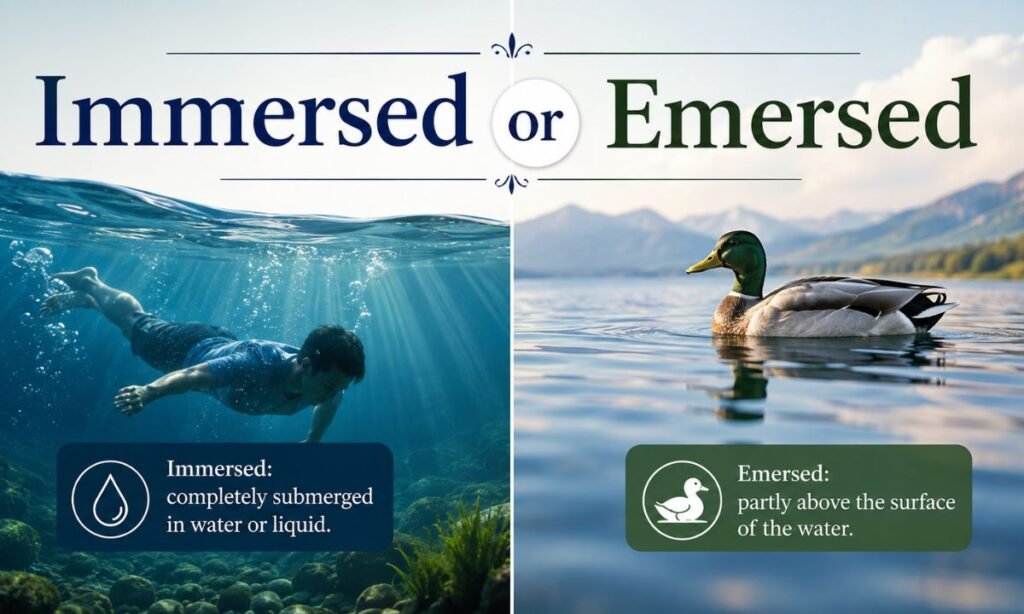
If you’ve ever typed “immersed” and then wondered whether “emersed” is even a real word, you’re not alone. These two words look almost identical but describe opposite situations, and mixing them up is one of the most common small errors in English writing.
In this guide, you’ll learn the exact immersed meaning and emersed meaning, where each word comes from, how spelling differs between British and American English, and how to use both words correctly in real sentences. By the end, you’ll never second-guess yourself again.
Immersed or Emersed: Quick Answer
Immersed means completely covered or submerged in something, usually a liquid, while emersed means rising out of or above a surface, usually water. They’re near-opposites, not spelling variants of the same word.
Think of it this way: immersed goes in, emersed comes out. That single distinction solves most of the confusion around immersed vs emerse.
Examples
- The diver was immersed in the ocean for over an hour.
- The lotus leaves were emersed, standing tall above the pond’s surface.
- She stayed immersed in her studies all weekend.
- The emersed roots of the mangrove were visible at low tide.
Related Post: Colum or Column: The Correct Spelling Explained Once and For All
The Origin of Immersed or Emersed
Both words trace back to Latin roots, and understanding their origin makes the difference much easier to remember.
Origin of “Immersed”
“Immersed” comes from the Latin word immergere, which means “to dip into” or “to plunge.” The prefix im- (a form of in-) means “into,” combined with mergere, meaning “to dip or sink.” So the immersed definition literally translates to being dipped into something.
Origin of “Emersed”
“Emersed” comes from the Latin emergere, meaning “to rise out” or “to come forth.” Here, the prefix e- (from ex-) means “out of,” attached to the same root mergere. The emersed definition therefore means rising out of a surface, typically water.
Why the Spellings Look Similar
Both words share the same Latin root, mergere, which is why they look and sound so alike. The only real difference is the prefix: im- (in) versus e- (out). This shared origin is exactly why so many people search for immersed or emersed which is correct, since the words feel like variants when they’re actually near-opposites.
British English vs American English Spelling
A common myth is that “emersed” is simply the British spelling of “immersed.” That’s not true. Both words are used in standard British vs American English spelling, and there’s no regional split between them, unlike words such as “colour” and “color.”
What does vary slightly is frequency of use. “Immersed” appears constantly in everyday British and American writing, while “emersed” is far rarer in casual speech in both dialects and shows up mostly in scientific and botanical contexts.
Comparison Table
| Feature | Immersed | Emersed |
| Meaning | Submerged, covered in liquid | Risen above a surface |
| Common in UK English | Yes | Rare, mostly technical |
| Common in US English | Yes | Rare, mostly technical |
| Everyday usage | Very high | Low |
| Scientific usage | Moderate | High (botany, biology) |
| Word origin | Latin immergere | Latin emergere |
Which Spelling Should You Use?
Neither word is a “correct” or “incorrect” version of the other. Which one you need depends entirely on meaning, not region.
For US readers
American writers use immersed for anything submerged, whether literal (immersed in water) or figurative (immersed in a book). Emersed is reserved almost exclusively for scientific or plant-related writing.
For UK or Commonwealth readers
British and Commonwealth English follow the same pattern. There’s no spelling variant to worry about here, just a meaning distinction between the two words.
Global audiences
For international or ESL readers, the safest approach is to learn the words by meaning rather than by region. If something is underwater, use immersed. If something is above the surface or emerging from it, use emersed.
Simple rule
If in doubt, ask yourself: is it going in or coming out? “Im-” pairs with “in,” and “e-” pairs with “exit.” This one trick resolves almost every case of immersed vs emerged confusion too.
Common Mistakes with Immersed or Emersed
Even confident writers slip up here. Below are the most frequent errors and how to avoid them.
Mistake 1: Using emersed instead of immersed
Writers sometimes type “emersed” when they actually mean fully submerged, perhaps mixing it up with “immersed” because of the similar spelling. Always check: are you describing something under the surface? Use immersed.
Mistake 2: Thinking both words mean the same
This is one of the most common mix-ups. Emersed vs immersed in culture, for example, are two completely different ideas — one means surrounded by a culture, and the other doesn’t apply here at all, since “emersed” wouldn’t fit a cultural context.
Mistake 3: Avoiding emersed entirely
Some writers avoid “emersed” altogether because they’re unsure it’s a real word. It is a legitimate, dictionary-recognized term, especially useful in botany when describing emersed aquatic plants that grow with leaves above water.
Mistake 4: Confusing with “emerged”
“Emerged” is the past tense of “emerge” (a verb describing an action), while “emersed” is an adjective describing a state or position. Comparing emersed vs emerged, the diver emerged from the pool, but the plant’s leaves are emersed above the water.
Mistake 5: Using immersed only literally
“Immersed” isn’t just for liquids. It’s frequently used figuratively, as in being immersed in work, immersed in a game, or immersed in thought. Limiting it to only physical submersion misses half its everyday use.
Immersed vs Emersed: Common Questions and Confusion Explained
Most confusion around these two words comes down to three things: their nearly identical spelling, their shared Latin root, and the fact that one of them (emersed) is rarely used outside specialized writing. People often type “immersed” when autocorrect or memory nudges them toward “emersed,” especially in unfamiliar or technical contexts like plant biology.
Another source of confusion is assuming these are simply immersed synonym and immersed antonyms in the same breath, when in fact “emersed” functions more like a technical opposite than a common everyday antonym. Everyday antonyms for immersed include “exposed,” “uncovered,” or “surfaced,” while “emersed” is the precise scientific term for that same idea in botanical and aquatic contexts.
Immersed or Emersed in Everyday Examples
Seeing both words used across different writing styles makes the distinction click faster than any rule alone.
Emails
“I’ve been fully immersed in the new project this week, so my replies may be delayed.”
News writing
“Researchers found that emersed leaves of the water lily developed differently than their submerged counterparts.”
Social media
“Just spent the weekend immersed in a new fantasy series. Zero regrets.”
Academic or formal writing
“The study compared growth rates of emersed versus submerged specimens under controlled light conditions.”
Casual conversation
“He was so immersed in the movie he didn’t hear the doorbell.”
Immersed or Emersed: Google Trends & Usage Data
Popularity
Search and usage data consistently show “immersed” is searched and used far more often than “emersed.” This lines up with real-world usage: “immersed” applies to countless everyday and figurative situations, while “emersed” is a niche technical term.
Regional interest
Interest in the exact phrase immersed or emersed which is correct tends to spike among students, writers, and content creators searching for quick clarification, rather than reflecting any true regional spelling divide.
Scientific contexts
“Emersed” sees its highest usage in botany, aquarium keeping, and wetland ecology, where distinguishing emersed aquatic plants from submerged ones matters for care and classification.
Contextual usage
“Immersed” dominates in psychology, technology (immersive experiences), literature, and daily conversation, while “emersed” stays largely confined to scientific and horticultural writing.
Comparison Table: Keyword Variations Side by Side
| Term | Category | Typical Use |
| Immersed meaning | Core definition | General/figurative use |
| Emersed meaning | Core definition | Scientific/botanical use |
| Immersed in water | Literal usage | Physical submersion |
| Emersed from water | Literal usage | Rising above water |
| Immersed vs emerged | Comparison | Adjective vs verb |
| Emersed vs emerged | Comparison | Adjective vs verb |
| Immerse vs emerse | Root verbs | Base forms of each word |
| Emersion vs immersion | Noun forms | Rising out vs going in |
Spelling, Meaning, and Grammar of Immersed and Emersed
Correct Spelling
There’s only one correct spelling for each word: immersed (with a double “m”) and emersed (with a single “e” prefix and single “m”). If you’re wondering how to spell emersed, just remember it drops the extra “m” that “immersed” carries, since it uses the prefix “e-” instead of “im-.”
Word Forms
| Base Verb | Present Participle | Past Participle | Noun Form |
| Immerse | Immersing | Immersed | Immersion |
| Emerse (rare) | Emersing (rare) | Emersed | Emersion |
Meaning Breakdown
- Immersed meaning in English: Fully covered, submerged, or deeply engaged in something.
- Emersed meaning in English: Standing above or having risen out of a surface, typically water.
🔹 Common Grammar Questions
Both words function as adjectives (and past participles) in most sentences. “Immersed” can also follow linking verbs, as in “she is immersed,” while “emersed” almost always describes plant parts or physical objects rather than emotional states.
🔹 Sentence Examples
- Immersed in a sentence: “The travelers were completely immersed in the local culture during their stay.”
- Emersed in a sentence: “The emersed stems of the plant caught the morning sunlight.”
Additional Insight: Immersed and Emersed in Aquarium and Garden Care
Beyond grammar, these two words matter practically for hobbyists. Aquarium and pond enthusiasts often need to know whether a plant grows better fully immersed underwater or emersed with its leaves above the waterline, since light exposure, humidity, and nutrient uptake differ significantly between the two growth forms.
Many aquatic plants, like certain Anubias or Cryptocoryne species, can actually adapt between both states, changing leaf shape and texture depending on whether they’re growing immersed or emersed.
Additional Insight: How to Remember the Difference Permanently
A simple memory trick: picture the letter “I” in immersed as a person standing straight down, sinking into water. Then picture the “E” in emersed as an arrow pointing out, like someone exiting a pool. Associating the prefix with direction, rather than memorizing definitions, makes the distinction stick far longer.
Frequently Asked Questions
Is “emersed” a real word?
Yes, “emersed” is a legitimate English word, most commonly used in botany and biology to describe parts of a plant that rise above water.
What is the opposite of immersed?
The general opposite of immersed is “exposed” or “uncovered,” while “emersed” is the specific scientific opposite used for plants and aquatic contexts.
Can “immersed” be used figuratively?
Yes, “immersed” is frequently used figuratively, such as being immersed in a book, a task, or a culture, not just literally submerged in liquid.
Is emersed the British spelling of immersed?
No, “emersed” is not a regional spelling variant of “immersed.” Both words exist independently in British and American English with different meanings.
What’s the difference between emersed and emerged?
“Emersed” is an adjective describing a fixed position above a surface, while “emerged” is the past tense verb form of “emerge,” describing an action of coming out.
Which word should I use for aquarium plants?
Use “emersed” when a plant’s leaves grow above the waterline, and “immersed” or “submerged” when the entire plant grows underwater.
Final Thoughts
Immersed and emersed may share the same Latin root and a nearly identical spelling, but they describe opposite physical states: one goes in, the other comes out. Once you connect the prefixes “im-” and “e-” to their directional meanings, the confusion disappears almost instantly.
Whether you’re writing an email, a research paper, or a caption about your latest aquarium setup, using these words correctly adds precision and credibility to your writing. Keep this guide handy the next time you pause mid-sentence, and you’ll never mix up immersed or emersed again.

Jessica is the founder and lead writer at Explain Wordz. She creates simple, accurate, and engaging content on English grammar, vocabulary, and writing to help learners improve their language skills with confidence.